Locally crafted games serve as powerful tools for developing numeracy skills in children, seamlessly integrating mathematical concepts into culturally rich, play-based learning. These locally crafted games foster cognitive growth by embedding foundational numeracy skills, such as counting, sorting, pattern recognition, and spatial reasoning, into activities that use natural, locally sourced materials like seeds, stones, or carved wooden shapes. For example, children might sort seeds by size or color to understand categorization, count clay balls to grasp basic arithmetic, which enhances logical thinking and problem-solving through numerical planning.
Socially, numeracy-focused games encourage collaboration, as children engage in group challenges (e.g., measuring distances in jumping games or tallying scores in team-based activities), fostering teamwork and communication while reinforcing mathematical concepts. These interactions also preserve cultural narratives, such as counting rhymes or stories involving trade and barter, that historically relied on numeracy in daily life, strengthening cultural identity and intergenerational knowledge transfer. Physically, games like weaving beadwork or arranging sticks into geometric shapes refine motor skills while introducing geometry and measurement concepts.
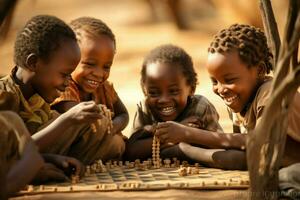
Locally crafted games nurture empowerment and cultural pride, bridging generational knowledge with childhood development.
Rooted in sustainability, these locally crafted games are cost-effective and adaptable to resource-limited settings, where formal educational tools may be scarce. However, challenges persist: modernization risks diluting traditional practices, and some games may inadvertently limit access to certain genders or communities. To address this, Right Path has integrated numeracy-focused variations of these games into early childhood daily learning, ensuring inclusivity and relevance. For instance, pairing storytelling with math puzzles has bridged cultural heritage with modern learning needs.
By embedding numeracy into play, locally crafted games not only nurture mathematical thinking but also empower children with a sense of agency and cultural pride. They transform abstract concepts into tangible, relatable experiences, whether through counting jackfruit seeds, navigating board games requiring strategic calculations, or measuring steps in outdoor races, proving that education thrives when rooted in tradition, creativity, and community.